

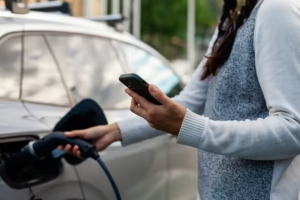
Sustainable technology is leading the way
There’s a new spark of good news in the world of sustainable technology - and this time, it’s about how long our vehicles are lasting. A recent study published in Nature Energy has found that electric vehicles (EVs) nearly match petrol cars in lifespan and comfortably outlive their diesel counterparts. On average, electric cars now last 18.4 years, compared to 18.7 years for petrol models and 16.8 years for diesels.
For years, one of the quiet reservations surrounding EVs has been longevity - particularly the durability of their batteries. Would electric cars stand the test of time, or would early adopters be left plugging into an uncertain future? The new data provides a resounding answer: innovation has caught up. Rapid technological progress has transformed electric mobility from an experiment into a robust, enduring reality.
The numbers tell a story of progress
The study examined MOT records from 300 million UK vehicles, giving researchers a uniquely detailed picture of how long cars actually remain roadworthy. MOT tests, of course, provide the annual measure of a vehicle’s fitness for continued use - a fair benchmark for comparing lifespans.
In the early days of electric mobility, battery electric vehicles (BEVs) often fell short on reliability. Cooling systems, software, and battery degradation presented real challenges. But as the researchers note, “...rapid technological advancements have allowed newer BEVs to achieve comparable lifespans, even under more intensive use.” In short: today’s EVs are built to last, reflecting a decade of concentrated effort across design, chemistry, and production.
What’s especially impressive is how quickly the field has matured. EVs have gone from being viewed as somewhat delicate to becoming almost indestructible symbols of efficiency. That durability translates directly into lower lifetime costs for consumers - one of the last major barriers to widespread adoption.
Norway leads the 'charge', and the UK isn’t far behind
Norway continues to set the global pace in the race to decarbonise transport. Last year, 88.9% of new vehicles registered in the country were electric - a figure that would have seemed almost utopian a decade ago. This remarkable transformation has been enabled by consistent policy support, smart infrastructure planning, and a deeply ingrained public commitment to sustainability.
Closer to home, the UK is entering a similarly pivotal phase. Analysts now believe we have passed “peak petrol”, meaning the highest point of petrol car ownership is already behind us.
EV uptake is accelerating not just because of regulation, but because of aspiration: drivers want smarter, cleaner vehicles that match their expectations for technology and performance.
This trend reflects something striking about how people’s values are evolving. The motivation to decarbonise isn’t simply a matter of compliance - it’s a vision of progress that spans homes, cities, and entire lifestyles.
The parallels between cars and homes
These findings resonate far beyond the car park. They speak to a shift in thinking about how technology integrates with longevity and sustainability. Just as the electric car has moved from novelty to normalcy, energy-efficient homes are undergoing a similar transformation.
In both fields - clean mobility and green retrofitting - the old trade-off between performance and sustainability is dissolving. Early electric cars required compromise: limited range, higher cost, uncertain reliability. Likewise, early retrofit measures were often perceived as costly or disruptive. Today, experience and innovation are turning both sectors into models of precision and dependability.
Energy-conscious homeowners now expect more from the buildings they occupy - not just warmth and safety, but intelligent performance that will last decades. Each purchase decision reinforces the other: upgrading one’s car and improving one’s house are both steps towards a quietly revolutionary 'normal'.
The economics of endurance
Perhaps the most powerful detail emerging from the Nature Energy study is the idea of resilience - the ability to perform efficiently over long stretches of time. For many consumers, durability is the most credible measure of sustainability. After all, the environmental cost of producing a car (or a building material) lies heavily in its manufacturing stage; extending useful life drastically improves its carbon arithmetic.
For EVs, this means that the embodied carbon of battery production - once seen as the Achilles’ heel of electrification - becomes proportionally smaller when the vehicle lasts 18 years or more. The same logic applies directly to building retrofits. High-quality insulation, triple glazing, smart ventilation, and heat recovery systems all deliver exponentially greater benefits when maintained and optimised over time.
Durability, then, isn’t just a 'nice-to-have' feature: it’s the foundation of carbon-conscious design. Both cars and homes prove that sustainability and longevity are not competing forces, but interdependent ones.
Technology and trust
There’s also a human factor underlying this shift: trust in technology. Confidence in innovation determines whether an upgrade feels worthwhile. The early scepticism toward EVs echoes the caution once shown toward heat pumps, airtight construction, or solar integration.
But trust grows from evidence - and that’s precisely what this study provides. The data signals that the age of 'fragile' green technology is over. Modern EVs are dependable, not experimental.
When purchasers see that the technologies underpinning decarbonisation - from batteries to building performance - are reliable and long-lived, enthusiasm replaces hesitation. That optimism fuels faster progress across the board.
The systems perspective
Another subtle but important connection lies in systems thinking. Transport, housing, and energy infrastructure can no longer be treated as isolated silos. The electrification of cars places new demands on the grid, creates opportunities for home charging integration, and even opens the door to vehicle-to-home (V2H) and vehicle-to-grid (V2G) energy systems.
Imagine a typical home of the near future: solar panels glinting on the roof, a high-efficiency heat pump warming clean air inside, and an electric car outside doubling as a mobile energy store. This integration means that energy no longer flows in a straight line from power station to socket. Instead, it circulates flexibly, intelligently, and efficiently - a living ecosystem made possible by long-lasting, mutually reinforcing technologies.
The recent study reminds us that endurance isn’t confined to any single product. It’s a shared language of sustainable systems built to work together.
Why longevity equals leadership
Electric vehicles lasting nearly two decades break the myth of planned obsolescence. They promise a new era in which reliability becomes the hallmark of green technology.
In an age of rapid change, longevity is a quiet form of leadership. The homes and cars of tomorrow won’t just consume less energy; they’ll remind us that sustainability is about lasting value, not fleeting novelty.
Looking ahead
The trajectory is clear. As data accumulates and confidence deepens, both EVs and home energy solutions will become woven seamlessly into the story of daily life.
The UK’s progress towards electrification - in mobility, housing, and the grid - is accelerating because of proven success stories like this one.
The optimism in the numbers from Nature Energy extends beyond cars. It’s a reflection of what happens when science, policy, and market demand all pull in the same direction. Then, decarbonisation stops being a challenge and starts becoming a habit.
Carl Dodd, Property Revolutions Ltd.

