

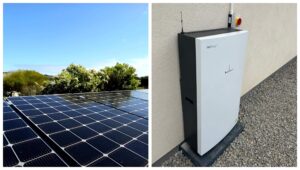
The PRL guide to solar & battery storage
The UK property sector is undergoing a quiet revolution. Whether you are a homeowner watching your monthly outgoings or a landlord aiming to future-proof an investment property, managing energy costs has become a top priority.
If you do not yet have solar panels installed, you are actually in an envious position, as you have a completely clean slate. While early adopters were forced to install solar panels as a standalone technology, the engineering landscape has evolved. Today, installing solar photovoltaics (PV) without a home battery storage system is seen as a job half-done.
For those looking at options to upgrade their property, deploying solar and battery storage together as a unified package is the single most effective way to slash utility bills, achieve energy independence, and boost property value.
Here we take you through how a combined system works, the profound financial and operational advantages it offers, and why doing both at the same time is one of the smartest investments you can make.
The core problem: why solar panels alone fall short
To understand why a battery is essential, we must first look at how a standard, standalone solar installation works.
Solar panels generate electricity when the sun is shining, peaking in output between 10:00 and 16:00. However, the typical UK household follows a completely different schedule. Most homes are relatively quiet during the middle of the day when occupants are out.
Household energy demand peaks sharply twice a day: in the morning before the school run, and in the evening between 16:30 and 20:30, when heating, cooking, lighting, and entertainment systems are all operating simultaneously.
Without a battery, a standard solar array achieves an average self-consumption rate of just 30% to 40%. The remaining 60%+ of your free, clean energy is automatically exported back to the national grid. Later that evening, when your panels stop generating, you are forced to buy back electricity from your supplier at standard peak retail rates.
The battery solution
A home battery storage system solves this mismatch. Instead of letting your surplus daytime solar generation leak back onto the grid, the battery captures it on-site. When the sun goes down and your evening routine begins, your intelligent system commands the battery to discharge.
Instead of drawing expensive electricity from the grid, your home runs on the free, clean energy you captured hours earlier. This immediately increases your self-consumption rate to 70%-80%, or more, fundamentally shifting the financial returns of your property.
Financial advantages: maximum ROI for homeowners and landlords
1. Eliminating peak import costs
The most immediate benefit is bill reduction. By running your evening appliances, heat pump, or electric vehicle (EV) charger off stored solar energy, you bypass the most expensive hours of the energy tariff. Over a full calendar year, these daily compounding savings translate from £100’s to £1000’s that you keep, rather than hand over to energy utilities.
2. Capitalising on smart time-of-use tariffs
Modern home batteries are highly intelligent, Internet-connected assets. When paired with dynamic UK energy tariffs (such as Intelligent Octopus Go or Octopus Flux), the system unlocks grid arbitrage.
During the darker winter months when solar generation is naturally lower, your battery can be programmed to automatically charge itself from the grid overnight when electricity prices are low (often around 7p to 9p per kWh). The system then holds that cheap energy and discharges it during the expensive morning and evening peaks. This ensures you never pay standard premium rates for your baseline power, regardless of the weather.
3. Next-generation export earnings
If your battery is fully charged, any remaining excess solar can be sold back to the grid.
By pairing storage with modern smart export tariffs, you can deliberately hold on to your power and export it back to the grid during peak "stress events" when utility companies are desperate for energy. This transforms your property from a passive consumer into an active micro-power plant that generates a reliable, secondary revenue stream.
4. Capitalising on the 0% VAT incentive
To encourage energy-efficiency retrofits, the UK government offers a substantial tax incentive. The supply and professional installation of qualifying energy-saving materials - which explicitly includes solar PV and battery storage systems - benefits from a 0% VAT rating until 31 March 2027.
Choosing to install both systems together under a single project saves you thousands of pounds in upfront installation costs, compared to executing them as separate, piecemeal jobs later down the line.
Crucial advantages for landlords
If you manage a portfolio or a single buy-to-let property, a combined solar and battery retrofit is an exceptional tool for securing and enhancing your investment:
• Attracting premium tenants: Energy bills are a primary concern for modern renters. A property that offers radically reduced living costs will always command a premium rental yield and experience significantly lower void periods.
• Boosting EPC ratings: The government continues to tighten Minimum Energy Efficiency Standards (MEES) for rental properties. Integrating solar and storage provides a massive boost to a building’s Energy Performance Certificate (EPC) rating, ensuring long-term compliance with Net-Zero regulations.
Lifestyle benefits: resilience and blackout protection
Beyond the financial spreadsheet, a combined solar and battery system introduces profound lifestyle advantages, chief among them being energy resilience.
Many property owners might assume that installing solar panels means their lights will stay on during a power cut. Unfortunately, standard grid-tied solar systems are legally required to shut down instantly during a blackout to prevent dangerous electrical feedback into utility lines where engineers might be working.
However, when you install a combined system featuring a hybrid inverter and an Emergency Power Supply (EPS) backup circuit, your home gains true off-grid capability.
During a localised grid failure, the system seamlessly disconnects from the national grid within a fraction of a second. It establishes an independent micro-grid, drawing immediate power from your battery and solar array. This keeps your essential circuits fully operational:
- Wi-Fi routers and home offices stay online.
- Fridges and freezers stay cold, preventing costly food spoilage.
- Essential lighting, heating controls, and security systems remain fully live.
As national infrastructure faces increasing strain from volatile weather events, this level of domestic security provides immense peace of mind.
Why a combined installation saves you money upfront
While it is technically possible to install solar panels now and add a battery a few years down the line, doing so as a single, combined retrofit project is significantly more cost-effective:
- Single installation costs: You only pay for scaffolding, structural engineering assessments, and professional electrical labour once.
- Optimised hardware: Installing both components simultaneously allows the engineering team to deploy a hybrid inverter. This single unit manages both the DC power from the panels and the DC power from the battery, eliminating the need to buy two separate, expensive inverters later on.
- Seamless integration: A unified system works perfectly right out of the box, with a single smartphone app monitoring your entire generation, storage, and consumption footprint.
Take control of your energy future
The days of relying entirely on unpredictable grid prices are over. A combined solar and battery retrofit is an investment that immediately lowers your day-to-day cost of living, insulates you against market volatility, and fully prepares your property for an electrified, low-carbon future.
Every home and rental property is unique, requiring careful consideration of roof orientation, shading, structural integrity, and household energy habits.
The off-season performance gap
There's a performance gap during the off-season months. I am going to install a small microturbine and use the half-price and free 10 hours to electric tariff to carefully match consumption and use.
Currently, I am over-generating 50% - which pays for the winter months. It also reduces my carbon debt for the embodied carbon that was accumulated in the house build. I am already operationally Net Zero (carbon neutral), but with over-generation, I can 'pay off' the other carbon, too.
With your own home - or the home/s that your tenants live in - if you decide that solar PV and battery storage is right for you, you’ll be investing in an all-round cleaner, more independent energy future.
Carl Dodd, Property Revolutions Ltd.

